3 Problems Of Dating, Relative And Absolute Chronology
As a preliminary remark one fundamental difficulty should at least be mentioned: the manuscripts on palmyra leaves can hardly be dated earlier than the 18th Century. In the climatic conditions of South India, the palm-leaf manuscripts perish very quickly.1 Fortunately, photostat copies of Tamil works on cadjan leaves of the 12. Cent. A.D. were made; the manuscripts were preserved in the much more favourable climate of Tibet. But, so far, they do not seem to be available for study.2 The manuscripts which were preserved have been copied, and the natural question arises whether the reading one obtains from these copies is that of the age of the copyist or that of the original, and to what extent they differ. Textual criticism, as it is understood in the West, has not yet been adopted by the editors of Tamil classics. Even such an erudite scholar and editor as Dr. U. V. Swaminatha Aiyar, clarum et venerabile nomen in the history of Tamil scholarship, did not strictly adhere to the principles of textual criticism. We know almost nothing about the manuscript traditions of the poems and anthologies, there are almost no specialized dictionaries, indexes and concordances, and not a single text has been critically and fully translated and interpreted finally, with the possible exception of the Paripāṭal, edited and translated by F. Gros, at Pondichéry, 1968 (see Bibliography).
1 One of the early Tamil editors, Ci. Vay. Tāmōtaram Piḷḷai (1832-1901), describes, in the preface to his edition of Kalittokai (1887), the difficulties of his editorial work: “Only what has escaped fire and water and religious taboo remains; even of this, termites and the insect called Rāma’s arrow take a portion; and the third element, earth, has its share, too … When you lift a palm-leaf manuscript, the edge brakes. When you untie the knot, the leaf cracks. When you turn a leaf, it breaks in half … All old manuscripts are falling apart one after the other and there is no one to make new copies”. According to M. C. Vēnkaṭacāmi (Pattoṉpatām nūrṛāṇṭil tamiḻ ilakkiyam 1800-1900, Madras, 1962, pp. 110-111), “unprinted texts in manuscripts were lost within one scholar’s memory or became available only in portions, the strings untied and the other parts lost”. Palm-leaf manuscripts are occasionally produced until this day: thus, e.g., I have in my possession a palm-leaf Ms. of Maṉmataṉ Katai, “The Story of the God of Love”, dated Aug.-Sept. 1952.
2 T. P. Meenakshisundaran, A History of Tamil Literature (1965), p. 5.
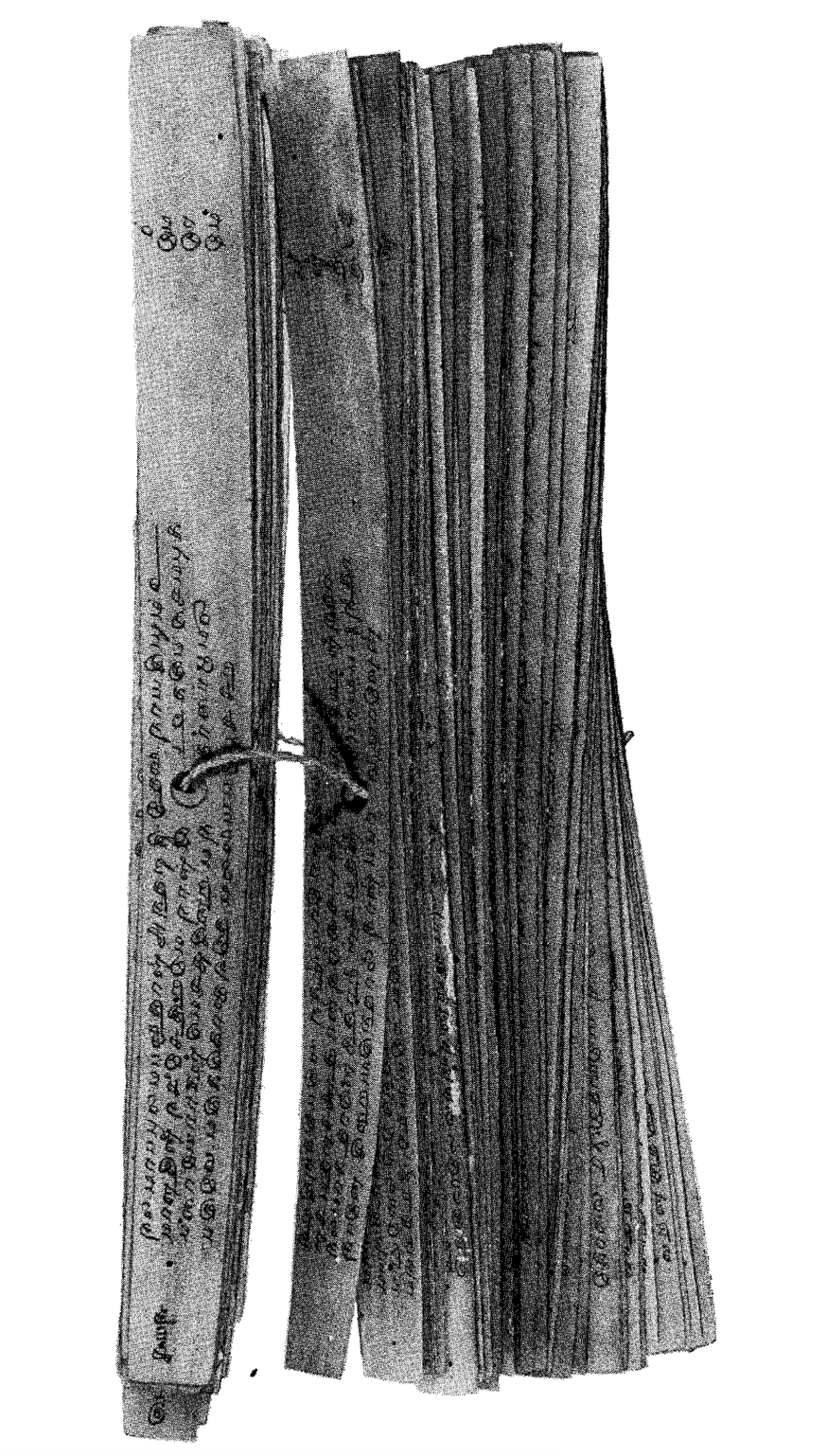
Also, there seems to have been a break in the traditional study of ancient literary works before they were rediscovered in the 19th Century. Many verses are missing even from those works which have come down to us. On the other hand, there was a tradition of interpolation—and this is very important for us when trying to reconstruct the original text of such works as the Tolkāppiyam. We know e.g. that a nun by name of Kantiyār is said to have included her verses in the Jain epic Cīvakacintāmaṇi (Nacciṇārkkiṇiyar’s Commentary on Cint. 3145, Irākava Aiyaṅkār’s ed. of Peruntokai 1549). Interpolations, elaborations of some episodes etc. have been probably added to the original texts: there are e.g. critics who maintain that the Periyapurāṇam and the Kamparāmāyaṇam contain quite a number of interpolations. And it seems to us that the Tolkāppiyam, too, contains some later additions.
Those who tried to solve the chronological questions pertaining to ancient Tamil texts did not pay much attention to what one may call the various stages in the life of the text. It is absolutely imperative to distinguish between these stages, otherwise one gets entangled in a hopeless mess resulting from the unfortunate fact of mixing these various stages and trying to date a work in question as one homogeneous whole.
Generally speaking, we have to distinguish the following stages in the life of a text:
- The creative act, that is the process of the actual composition of a text.
- The period of oral transmission of the text.
- The compilation of anthologies of texts.
- The redaction (Germ. “Redaktion”), i.e. the editing and codification of the anthologies.
- The stage of commenting upon the texts; the composition of commentaries and super-commentaries.
- The critical edition or at least the preparation of a modern edition which is more or less in agreement with the principles of textual criticism.
The creative act. Several authors, lastly K. Kailasapathy (Tamil Heroic Poetry, 1968) have conclusively shown, that the earliest Tamil poetry was composed in agreement with the conventions of an oral bardic tradition, and that, obviously, a great body of oral bardic literature preceded and was incorporated into the earliest corpus of Tamil literature. Though writing as such was known in the Tamil land during or immediately after the reign of Aśoka, and the Tamil-Brāhmi script was fully adapted to the language probably sometime in the 2nd Cent. B.C., it is highly probable that for a long time writing was used only for inscriptional purposes and, later, for grants, royal papers, letters written in royal chancelleries; only much later for literature as such. The creative act must have been purely oral; the early poems show unmistakable features of oral poetry, of oral composition, destined for audience appreciation and not visual “consumption” of literature.
Thus the period of oral transmission was an unusually long one. As a random example we may give poems numbers 4 and 143, 144 and 145 of the Puṟam collection, ascribed to the well-known poet Paraṇar, who composed these songs probably sometime in the middle of the 2nd Cent. A.D. Perhaps as many as six centuries went by until a certain Peruntēvaṇār of 8th Cent. A.D. compiled a number of bardic poems into one single anthology of four hundred of them, and provided this anthology with an invocatory stanza; this anthology goes since then by the name of Puṟanāṉūṟu or Puṟam.
The same man was very probably responsible for the anthologization of a great number of other early bardic poems (Akanānūru, Aiṅkuṟunūṟu, Kuṟuntokai and Naṟṟiṇai). We may say that the majority of the earliest texts were compiled into anthologies some time in the middle of the 8th Cent. if not later (some authors date Peruntēvaṇār into the 9th Cent.).
The next stage—that of the final redaction and codification of the various anthologies into greater corpora—is even later. The earliest Tamil poetry was compiled into two great anthologies, the Eṭṭuttokai, “Eight collections”, and the Pattuppāṭṭu, “Ten Lays”, but the names themselves occur for the first time only in Pērāciriyar’s commentary to Tolk. Poruḷ. 362 and 392 where he speaks about pāṭṭu and tokai, that is in the 13th-14th Cent. A.D.; and by Mayilainātar, a commentator of the grammar Naṇnūl (also in the 13.-14. Cent.); he speaks about eṇperuttokai and pattuppāṭṭu (s. v. 387: aimperuṅkāppiyam, eṇperuttokai, pattuppāṭṭu, patineṇkīḻkkaṇakku). Before that, though the individual anthologies are mentioned and cited by various commentators, the two great anthologies of Eṭṭuttokai and Pattuppāṭṭu never figure in these commentaries: e.g. in the commentary on Iṟaiyaṉār Akapporuḷ by Nakkīrar (8th Cent. A.D.) or in Iḷampūraṇar the earliest commentator on Tolk., in the 12th Cent. Thus it seems that the final codification of the texts into the two great anthologies has not been made before 13.-14. Cent. A.D.
The ancient literature, once it was anthologized, and especially after its final codification, was submitted to extensive comments, annotations and interpretations by medieval scholiasts; this period of great commentaries starts probably in the 8th Cent. A.D. with Nakkīrar’s commentary on Iṟaiyaṉār’s Akapporuḷ and Iḷampūraṇar’s commentary on Tolkāppiyam, and ends with Nacciṉārkkiṉiyar’s commentaries of the 14th Century. Later, a great number of miscellaneous lesser commentaries were written, and those of them that are available form a literature in themselves. Taking as an instance, again, the stanzas in Puṟam, an ancient anonymous commentary is available up to stanza No. 266 of this collection; apart from that, there exists a modern super-commentary by Auvai S. Doraiswami Pillai to the whole anthology.
Finally, beginning with late 19th Cent., the early poetry was being published in many editions of different kind and quality. Thus e.g. the anthology Puṟanāṉūṟu was published in 1894 by the great U. V. Swaminatha Aiyar in what is an approximation to a critical edition.
Another problem which is involved in the general question of dating and chronology of the early works is the fact that a number of literary personalities occur under one and the same name, and very many writers and editors have committed the mistake of regarding persons bearing identical name as identical people. Thus we have e.g. Auvaiyār who comes in the pre-Pallavan age of so-called Caṅkam literature; another Auvaiyār appears as a contemporary of Cuntarar in the Pallava age; and a third Auvaiyār, the author of the popular didactic works, appears in the later Chola age as a contemporary of Oṭṭakkūttar. There was also the habit of later writers assuming the names of great poets of a previous age: this may be the case of Kapilar. There are at least three poets going by this name: one who is sometimes called Tol-Kapilar or the “Old Kapilar” (cf. colophon to Akam 282 etc.), then Kapilar the Great—“the prince” of the so called Caṅkam poets, and finally the late Kapilar, the author of the late-medieval Kapilarakaval, an antibrahminic outcry.
We have at least two Nakkīrars: the older Nakkīrar might have lived round about 250 A.D. and was the author of some very fine poems in the anthologies. A later Nakkīrar is the author of Tirumurukāṟṟuppaṭai; and probably the same man composed the commentary to Iṟaiyaṉār Akapporuḷ in the 8th Cent. A.D.3 Certain works elaborated by a series of scholars in a particular school of thought were sometimes named after their original teacher and guru: such may be the case of Tolkāppiyam, or rather its third portion, which is probably much later than the basic parts of the first two portions but goes, too, under the name of Tolkāppiyar.
3 The identity of these two Nakkīrars is still a disputed question. To be precise, there are actually more Nakkīrars than two in Tamil writing. Many bards bore the name of Kīrar (e.g. Kuṭṭuvaṉ Kīraṉār, Maturai Nakkīrar, Viḷaṅkīraṉār). Of the better known Nakkīrars, there may be three or four:
1. Nakkīrar the bard, the author of the lyrical pieces in the tokais.
2. He is probably identical with Nakkīrar, the author of the beautiful lay “The Long Good Northern Wind”. A.D. 215 (?).
3. Another Nakkīrar, the author of Tirumurukāṟṟuppaṭai. Cca 700-800 A.D.
4. He may or may not be identical with Nakkīrar the author of the commentary of Iṟaiyaṉār’s Kaḷaviyal (that is with Maturaik Kaṇakkāyaṉār Makaṉ Nakkīrar). Cca 700-800 A.D.
5. One or more Nakkīrars, author(s) of some of the poems which are included in the 11th Tirumuṟai (Saiva Canon).
Finally, there is the problem of the language of the earliest literature: the uniformity of the language is part of the whole picture of the uniformity and homogeneity of the poetry itself; the linguistic matter of the early bardic poetry is a highly standardized, conventionalized language making use of stereotype formulae; it is a normalized, highly polished language of a high literary style. On the other hand, one should always bear in mind that this literature is a corpus of poems arranged, as pointed above, much later into collections and hyper-collections and that, consequently, these anthologies contain material of very different age and antiquity, ranging probably from the 2nd-1st Cent. B.C. to the 3rd or 4th Cent. A.D. The fact that not much linguistic development is detectable within the bulk of the earliest poems is due to the conventionalized, in some ways petrified, “frozen”, linguistic norms.
One extreme case was to date these texts between the 9th-10th and the 13th Cent. A.D. These attempts are no more seriously considered nowadays, though in the earlier editions of the Encyclopaedia Britannica or in the writings of the French scholar Julien Vinson this was the accepted dating. However, neither Vinson nor Rost, the author of the pertinent lines in the Encyclopaedia Britannica, had access to the earliest texts; they were not aware of their existence (Vinson knew only one of the anthologies, Kalittokai, which is anyhow a later collection, Caldwell and Rost considered the Tirukkuṟaḷ to be the earliest Tamil literary work). This dating of the beginnings of Tamil literature can be thus dismissed without any further ado.
Swamikannu Pillai’s is a much more serious attempt: he dates the bulk of the earliest poetry into the 7th-8th Cent. A.D. (his calculations are based on astronomical data and result in the date 756 A.D. for the epic poem Cilappatikāram, and 634 A.D. for Paripāṭal, one of the Eight Anthologies). He gives a few additional reasons; they need not be discussed in detail, since this dating in general goes against the evidence of the history of South India, against the internal linguistic evidence, and against some other considerations, e.g. of the prevalent religious situation (a period of absolute tolerance for Buddhism and Jainism during and immediately after the earliest literary period as opposed to the intolerance typical for the age of the Pallavas, characteristic for the beginnings of militant Hinduism in the South).
The most plausible date for the bulk of early Tamil literature is the 2nd Cent. A.D. This date, suggested by G. K. Sesha Iyer on the astronomical computation of the great fire of Madurai in 171 A.D., was taken up by K. A. Nilakanta Sastri and S. Vaiyapuri Pillai who, I think, were the first to prove more or less conclusively, especially in A Comprehensive History of India, Vol. II, 1957, that the bulk of the earliest Tamil lyrical poetry was composed between 100-250 A.D.
Let us now examine in detail the external and internal evidence for this date, as presented by K. A. Nilakanta Sastri, and as supported by the contemporary and rather conclusive testimony provided by the historical analysis of the early Tamil Brahmi inscriptions and some other material.
The earliest Tamil literature extant has been preserved in two great super-anthologies, the Eṭṭuttokai and the Pattuppāṭṭu. Listing 3.1 gives the titles of the various eight anthologies of the great collection, and the names of the ten lays contained in the second great anthology, in their traditional order.
It has been noted, and nowadays only the most stubborn of the traditional pandits would not admit this fact, that out of the eight collections of the first great anthology, two, namely the Paripāṭal and the Kalittokai are, in their entirety, later than the rest. As far as the second great anthology is concerned, at least one poem is undoubtedly of later origin than the rest, namely the Tirumurukāṟṟuppaṭai. Thus we are left with six anthologies of Eṭṭuttokai and with nine pāṭṭus or lays of Pattuppāṭṭu.
Eṭṭuttokai “Eight Collections”
- Naṟṟiṇai “(The anthology of poems about) the good tiṇais”
- Kuṟuntokai “The anthology of short (poems)”
- Aiṅkuṟunūṟu “The five hundred short (poems)”
- Patiṟṟuppattu “The ten tens”
- Paripāṭal “(The composition in the) paripāṭal metre”
- Kalittokai “The anthology in the kali metre”
- Akanāṉūṟu or Netuntokai “The four hundred (stanzas) about akam” or “The anthology of long (poems)”
- Puṟanāṉūṟu “The four hundred (stanzas) about puṟam”
Pattuppāṭṭu “Ten Lays”
- Tirumurukāṟṟuppaṭai “The guide to Lord Muruku”
- Porunarāṟṟuppaṭai “The guide for the war-bards”
- Ciṟupāṇāṟṟuppaṭai “The guide for the bards with the small lute”
- Perumpāṇāṟṟuppaṭai “The guide for the bards with the large lute”
- Mullaippāṭṭu “The song about the forest (life)”
- Maturaikkāñci “The reflection on Maturai”
- Neṭunalvāṭai “The good long northern wind”
- Kuṟiñcippāṭṭu “The song about the hills”
- Paṭṭiṉappalai “(The poem about) separation (and about) the city”
- Malaipaṭukaṭām “(The poem of the sound) kaṭām pertaining to the mountains”
It seems to me reasonable to assume that the earliest poetry began first to be fixed in writing, and later anthologized, as soon as it ceased to be part of a living tradition, in other words, as soon as it ceased to be a living, orally transmitted poetry for audience appreciation. With the cessation of a living bardic tradition, probably sometime in the so-called dark age of the Kalabhras, round about the middle of the 1st millennium, this earliest poetry ceased to be created, sung, and orally transmitted; at this time or slightly later, it presumably became a kind of “frozen”, classical literature, which had definitely run out as a living literature during the first great wave of devotional poetry under the Pallavas. It gradually became a matter of interest only for the scholar, for the savant, for the erudite litterateur; it also became progressively more unintelligible, for the language changed as well as the conventions and subject-matter of poetry. That was probably the period when, for the first time, a need was felt for commentaries and theoretical treatises dealing with this classical heritage. This heritage was ultimately preserved only and exclusively by the learned poets (not by the popular poets), and by the scholiasts and commentators. Even the scholiast and the commentator ceased to be interested during the late medieval times, until in fact this early poetry faded into oblivion and had to be rediscovered in almost modern times.
The “rediscovery” of ancient Tamil literature occurred in the transition period of the later 19th Cent. when—to employ the happy phrase of A. K. Ramanujan—“both paper and palm leaf were used’. The two men most responsible for making possible this very transition were Damodaram Pillai (1832-1901) and U. V. Swaminatha Aiyar (1855-1942).
It has just been stressed that the anthologization is much later than the actual creation of the poetry, and that the final codification is very probably, again, much later than the anthologization. The name Peruntēvaṉār was mentioned before. Five of the six earlier collections of the Eṭṭuttokai hyper-anthology are introduced by Peruntēvaṉār’s invocatory verses: Akanāṉūṟu, Aiṅkuṟunūṟu, Kuṟuntokai, Naṟṟiṇai, and Puṟanāṉūṟu. A certain Peruntēvaṇār is quoted as the author of a Tamil version of the Mahabharata (this campū work has unfortunately reached us only as a fragment). A few verses of this Pāratam are quoted in the commentaries.4 It may probably be dated into the middle of the 8th Cent. These two persons are probably identical, since the Perutēvaṇār who wrote these introductory verses to the ancient anthologies is referred to persistently as pāratam pāṭiya peruntēvaṉār, “The Peruntēvaṉār who the Bhārata”. Whether this man was also the compiler of sang the anthologies is a problem. It is only a hypothesis, though a plausible one. One thing is clear: the anthologization of the poems seems to be much later than their actual composition and corroborative evidence may be drawn from the fact that even within the collections themselves poems of rather different antiquity may be found: thus, e.g., the majority of the poems collected in the Kuṟuntokai anthology belongs probably to the 1st Cent. B.C.-2nd Cent. A.D.; but the same anthology contains a poem, Kur. 2, ascribed to Iṟaiyaṉār, the author of Akapporuḷ, probably of the 5th-6th Cent. A.D.
4 This work seems to have been composed in the veṇpā metre interspersed with prose. Cf. Nacciṉārkkiṉiyar’s comm. on Tolk. Purattiṇaiyiyal 17.21, and the commentaries to Vīracōḻiyam, Poruṭpaṭ 15 and Alaṅkārappaṭ. 12, 18, 29.
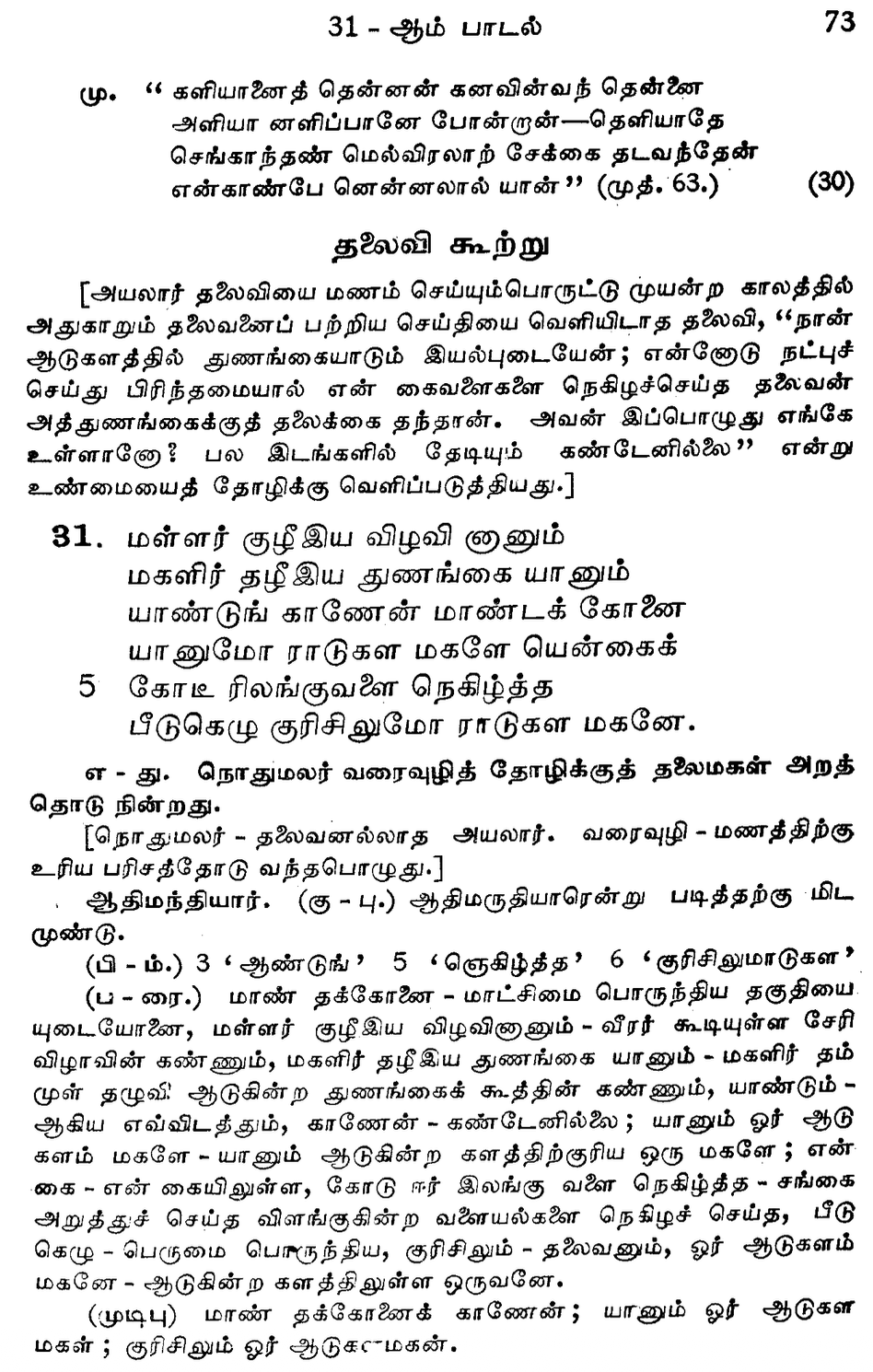
It has already been stressed, too, that the final codification of the earliest extant poetry must have been later than the compilation of various anthologies. Of crucial importance for this hypothesis is the silence maintained by the famous commentary by Nakkīrar on Iṟaiyaṉār’s Akapporuḷ; Nakkīrar speaks in detail about the early poetry, he gives a full account of the legend of the Caṅkam (Academy), but he never mentions the great anthologies. Though an argumentum ex silentio, it is rather persuasive.
The work itself is very interesting. Composed some time in the 5th-6th Cent. A.D., it is probably the most ancient of the theoretical works on the akam and puṟam genres (probably older than the Poruḷatikāram of the Tolkāppiyam). The work has been attributed (by a credulous generation) to the God Śiva himself because the name of its author, Iṟaiyaṉār, can be interpreted as God or Śiva. There is also a poem, Kur. 2, which is attributed to Iṟaiyaṉār. Another name of the treatise is Iṟaiyaṉār Kaḷaviyal. It deals exclusively with the akam genre—a lucid, continuous text; though much of it does not require a commentary, it obtained one, and this commentary is ascribed to one Nakkīrar who is definitely different from the poet Nakkīrar of the early anthologies, but also different from the author of Neṭunalvāṭai, one of the “Ten Lays”. However, he may be identical with the poet who composed Tirumurukāṟṟuppaṭai, a very late poem of the “guide” genre. The date of this commentary is a matter of dispute. If the two Nakkīrar’s are identical then the date could be anything between the 6th-7th and 8th Cent. A.D. If they were not identical, the commentary could be as late as the 10th-12th Cent. But I would be inclined—for a number of reasons which I cannot go into here5—to regard the poet and the commentator as one and the same man, and set the date of the commentary at about 750 A.D. A tradition maintains that the commentary was composed by the poet Nakkīrar and was transmitted orally for eight generations until it was written down by a Nīlakaṇṭaṉ of Muciṟi.
5 The commentary on Iṟaiyaṉār Akapporuḷ uses the similes taken from the description of pre-marital love as found in the Peruṅkatai, cf. Iṟaiyaṉār Akapp. sūtra 2 (ed. 1939), p. 38: Peruṅkatai I, xxxii, 17 and 18. Peruṅkatai is earlier than the 10th Cent., but certainly not earlier than cca 700 A.D. Durvinita’s Bṛhatkathā, very likely the model of Peruṅkatai, was composed probably in the 1st half of the 7th Cent. For the upper limit cf. the fact that Pāṇṭikkōvai (by an unknown author) written probably in the 8th Cent. (since it is crammed with references to the victories of the Pandya kings of the 7th and 8th centuries), is a collection (kōvai) of poems out of which about 250 have been preserved, and the major portion of these are taken from the commentary on Iṟaiyaṉār Kaḷaviyal (Akapporuḷ). Nakkīrar’s commentary, though regarded by many as inferior to the text itself, has descriptive passages of literary beauty, with alliterations and assonances, and they can even be metrically scanned (see chapter 16 of this book; cf. also T. P. Meenakshisundaran, HTL 173).
6 This can be inferred e.g. ab intra from the manner in which the commentary itself proceeds, cf. utterances like urai naṭantu varāniṉṟamai nōkki, or ini urai naṭantavāṟu collutum, or iṅṅaṉam varukiṉṟatu urai. The commentary is said to “proceed”, “to come down” to us, obviously through oral tradition. That the commentary very probably contains later interpolations was recognized already in 1938 by R. Narayanan of Jaffna who describes it as a “commentary which has come down to us with innumerable alterations”. These interpolations are probably responsible for S. Vaiyapuri Pillai’s opinion expressed in Kāviyakālam pp. 215-216 where he tries to show that the commentary in its present form is clearly indebted to Cīvakacintāmaṇi (10th Cent.). On the other hand, there is a persistent and early tradition that Nakkīrar was the author of the commentary, cf. Nacciṉārkkiṉiyar’s comm. on Tolk. Poruḷ. p. 808, and Poruḷ. Marapu 814. This commentary uses once the term elutiṉāṉ “he wrote (down)“, cf. ivvurai ceytār yārōveṉṟavuḻi maturaik kaṇakkāyaṉār makaṉār nakkīrareṉa urai yelutiṉāṉ (instead of the prevalent urai kaṇṭavaṉ). V. S. C. Pillai is probably right when he says that Nakkīrar composed the main outlines of his commentary, which was then orally transmitted probably for about 200-300 years, until sometime in the 10th Cent. it was written down by Nīlakaṇṭar who also gave an introduction and supplied the commentary with additional and”modern” quotations. The date of the commentary was first set as 8th Cent. A.D. by V. Kanakasabhai Pillai in The Tamils 1800 Years Ago (1904). Cf. also Chapter 16 of this book.
This tradition is not at all absurd. Lately we have come to regard such and similar traditions with more credulity than in the age of pure empirical positivism. It was after all found out that many persistent indigenous traditions (e.g. the one incorporating the famous Gajabāhu synchronism) may be on the whole trusted. While the commentary itself was very probably composed by a Nakkīrar of the 8th Cent., it again very probably was transmitted orally until it was fixed as a written text by Nīlakaṇṭaṉ of Muciṟi.6 This commentary of Nakkīrar is actually one of the first specimen of Tamil prose, not bits of unmeasured verse as in Cilappatikāram, but pages and pages of genuine prose (ornate, poetic, alliterative, metaphorical, and full of similes).
I am dealing with this work and its commentary at this length because it will again and again be mentioned (especially while discussing the legend of the Caṅkam, and because it very probably is the first theoretical treatise on the poetic conventions of ancient Tamil). What one has especially to bear in mind is the distinction in date between the text itself and its commentary. Let me repeat: the text was composed probably sometime between the 4th and 6th Cent. A.D. The commentary—round about 750 A.D.
It has also been said that the earliest commentator on the Tolkāppiyam, Iḷampūraṇar, who was given the distinguished title uraiyāciriyar, i. e. The Commentator (and he deserves this title), and who probably belonged to the 12th. Cent., does not mention the anthologies. In the 13th-14th Cent., however, three commentators, Mayilainātar, Pērāciriyar, and Nacciṉārkkiṉiyar, mention by name the two great anthologies; hence we may assume that the final codification of the poems occurred sometime between the 12th and 13th Centuries.
Now we finally come to the problem of the external and internal evidence for the dating of the earliest literature of the Tamils.
Let us first consider the purely historical correlations. According to G. Jouveau-Dubreuil (The Pallavas, 1917, p. 10), the beginnings of the Pallava dynasty of Kāñci is to be dated sometime in the first half of the 3rd Cent. A.D. In the 6th and 7th Cent. A.D. the Pallavas were one of the most powerful and important South Indian dynasties. The first important Tamil Pallava inscription may be dated roughly in 550 A.D. In the earliest Tamil poetry, there is not a single allusion to the Pallavas, they are not mentioned at all, though much of this poetry, especially in the Patiṟṟuppattu and Puṟam collections, is of quasi-historical nature and mentions a number of Indian, particularly Tamil dynasties, dynastic names, events etc. True, this is an argumentum ex silentio, yet one can hardly assume that such a powerful dynasty and state as that of the Pallavas would not have been mentioned at all in a corpus of more than 2000 poems! We may therefore safely assume that this earliest strata of literature is pre-Pallava, that is pre-3rd Cent. A.D. Now this conclusion fits well with other lines of evidence derived from other data on South Indian history. What are these other lines of evidence?
- First of all, there are the data of Graeco-Roman authors. The Greek and Roman trade is well attested by the early Tamil texts themselves: the poems speak of Yavanas7 and their ships, of their gold coins and Yavana wine etc., and these poems speak about the Western merchants and their trade with the South as a well-known, widely popular and contemporary fact; allusions to this foreign Western-oriented trade are of such nature that we must assume this Roman and Western trade to have been a simple fact of daily life of those who listened to these early poems. It was shown conclusively that the Greek and Roman trade could not have continued in any considerable extent after the 2nd-3rd Century.8
7 There are about ten references to the Yavaṉas in the Caṅkam texts: Mullaip. 61, 66, Perumpāṇ. 316, Patiṟṟup. II, Akam 57, 149, Neṭuṉal. 31-5, 101-2, Puṟam 56 and 353. The Yavaṉas served as body-guards to kings (Mullaip. 66) and as palace-guards during the night (ib. 61). They were a drinking, freely-moving people, decorating themselves and walking along the city-streets during nights (Neṭunal. 31-5). They were merchants, too; they brought lamps of fine workmanship, swan-shaped and woman-shaped (Netunal. 101-2, Perumpāṇ. 316-19); they came with gold and wine in their ships and returned with pepper (Akam 149, Puṟ. 56, 343), and one of the ports they most frequently visited was Muciṟi (Akam 57, 149, Puṟ. 343). Cf. P. Meile, “Les Yavanas dans l’Inde tamoule”, Journal Asiatique 323 (1940) 85-123, and K. Zvelebil, “The Yavanas in Old Tamil Literature”, Charisteria Orientalia, Praha 1956, 401-409.
8 Cf. E. H. Warmington, The Commerce Between the Roman Empire and India, Cambridge, 1928, M. P. Charlesworth, Trade-routes and Commerce of the Roman Empire, Cambridge, 1926. Further Tamil Culture Vol. I, No. 1, 286-295; also A. Ayyappan, “A Dakshina Taxila”, The Hindu, Madras, 23.3. 1941, L. Faucheaux, Une vielle cité indienne près de Pondichery, Virampatnam, Pondichéry, 1945, P. Z. Pattabiramin, Les fouilles d’Arikamedu (Pôdoukè), Pondichéry-Paris, 1946, but especially the exhaustive account by Sir R. E. M. Wheeler, A. Ghosh and Krishna Deva, “Arikamedu: an Indo-Roman Trading Station on the East Coast of India”, Ancient India 2, July 1946, 17-124; further J. M. Casal, Fouilles de Virampatnam-Arikamedu, Rapport de l’Inde et de l’Occident aux environs de l’ère chrétienne, Paris, 1949. Also Albin Lesky, Geschichte der griechischen Literatur, 2. Aufl., Bern (1963), p. 865. Tamil India as described in the so-called Caṅkam poetry was quite well-known to such Western authors as Pliny the Elder (75 A.D.), Ptolemy (130 A.D.), and above all to the anonymous, charming author of the Periplus Maris Erythraei (cf. W. H. Schoff, The Periplus of the Erythraean Sea, New York, 1912, cf. its new dating in ca. 240 A.D. by J. Pirenne in J.A. 1961, also K. A. Nilakanta Sastri, Foreign Notices of South India, Madras, 1939). The excavations in Virapatnam-Arikamedu near Pondicherry point to an old Roman settlement, proving that the Yavaṉa settlements referred to in the very early anthology Patiṟṟuppattu (Patikam 2) are not figments of imagination. Roman imperial coins of gold and silver were imported in considerable quantities and circulated freely in the country; there were probably small copper coins bearing Roman devices and legends produced locally. In the Greek and Latin sources we have scores of Tamil and South Indian names both local and dynastic, which again and again occur in the earliest poetry of the Tamils (e.g. Tyndis-Toṇṭi, Kolchoi-Koṟkai, Muziris-Muciṟi, Modoura-Maturai, Khaberis Emporion-Kāvirippattiṉam, etc. etc.), cf. F. B. J. Kuiper, “Two Problems of Old Tamil Phonology”, IIJ (1958), pp. 219-221.
This cumulative evidence of the early Tamil texts themselves, of the Greek and Roman authors, and of archeological data are fully supported by the internal evidence present in the texts themselves: here I have in mind not the historical, but linguistic and philological evidence, derived from the state of development of the Tamil language, and from the considerations about the prosody of early poetry. This linguistic evidence tells us quite convincingly, first, that there are problems of relative chronology involved with respect to the age of the various texts themselves, and, second, that as a whole, the earliest poetry must be quite obviously much older than the first beginnings of the devotional bhakti literature of the 7th Cent. The language of the early poetry shows many decisively older forms; to give a few diagnostic examples: the OTa. yāṉ “I” occurs in Appar’s songs (eg. Patikam 305. 1-10) as nāṉ, undoubtedly a later form; OTa i “this” gives way to Middle and Modern Ta. inta in Campantar (Pat. 4. 11); OTa. has no double plural marker, whereas Tēvāram, the anthology of bhakti hymns, abounds in it (eg. Campantar, Pat. 2; 9, 10); the Old and LTa. aintu “five” appears in Campantar 237. 4, as añcu; the present morph—kiṉṟ—which, in the OTa. texts, is very sporadic (a few instances), is rather frequent in Campantar, Pat. 2, 3-4, Pat. 235, 1, etc.
In short, the language of the Tēvāram devotional hymns presents an entirely new and later stage of development in its morphology and lexis; and the prosody, too, is very different and shows much more influence of the Sanskrit mātrā-type of metrics. All this shows beyond doubt that the language of the early poetry must be at least a few centuries older than the language of the Saiva and Vaiṣṇava hymns, the first of which were composed in the 6th-7th Cent.We shall discuss the relative chronology of the various texts later. Now we have to ask a very basic question: is there any positive, concrete datum which would serve as a point of departure for an absolute chronology of the earliest Tamil texts? I believe that there is such a date, though it is still hypothetical. This hypothesis, however, which has been strongly supported by two other kinds of data, by evidence derived from the earliest Brāhmī inscriptions, and by a bilingual coin, seems to me to be, to date, a rather firm sheet-anchor for the chronology of early Tamil India. In any case, it is not quite true what H. W. Schomerus wrote a few decades ago in his account of Tamil literature, namely, that the beginnings of Tamil literature are enshrouded in complete darkness. (“die Anfänge der Tamil-Literatur liegen völlig im Dunkeln”).
In the well-known Tamil epic poem, The Lay of the Anklet, we may read, in the 30th Canto, 160, the following line: kaṭalcūḻ ilaṅkaik kayavāku vēntaṉ. The whole passage reads: “The monarch of the world circumambulated the shrine thrice and stood proferring his respects. In front of him the Arya kings released from prison, kings removed from the central jail, the Kongu ruler of the Kudagu, the king of Malva and Kayavāku, the king of the sea-girt Ceylon, prayed reverently to the deity thus …” (Dikshitar’s transl., p. 343).9 According to Cilappatikāram, Gajabāhu (the First) of Ceylon was contemporary with the hero of the 3rd Canto of the epical poem, the Chera king Ceṅkuṭṭuvaṉ. Hence this great Cēral monarch who according to Patiṟṟuppattu V ruled for 55 years, may be roughly assigned to 170-225 A.D. (S. Vaiyapuri Pillai, HTLL, p. 22).10
This computation has been known as the Gajabāhu Synchronism and it has become a sheet-anchor of early Tamil history, and our basic point of departure for dating the earliest Tamil literature. Though it rests on slender foundations, it is obvious from the plentiful corroborative evidence “derived from the general possibilities of history in Northern and Southern India” (K.A. Nilakanta Sastri) that the epic poem preserves elements of a correct historical tradition and that Ceṅkuṭṭuvaṉ the Cēral and Gajabāhu I of Ceylon were contemporaries, both living round 180 A.D. The opinion that the Gajabāhu synchronism is an expression of a genuine historical tradition is accepted by most scholars today; apart from K. A. Nilakanta Sastri, by Seshagiri Sastri, Kanakasabhai Pillai, Krishnaswami Aiyengar, K. Kailasapathy etc. (cf. Vaiyapuri Pillai, HTLL, p. 22: “We may be reasonably certain that the chronological conclusion reached above is historically sound”).
9 For the first time, the “Gajabāhu synchronism” was made the centre of attention by V. Kanakasabhai Pillai, The Tamils 1800 Years Ago (1904), p. 7; he however dates Gajabāhu I in 113-125 A.D., which was proved incorrect.
10 In Ceylonese history, there were two kings by name of Gajabāhu: since the second ruled as late as in the 12th Cent., it must be the first who is meant here. Gajabāhu I is mentioned in Mahāvaṃso XXXV, pp. 253-5 as follows: “After Vankanasikatissa’s death, his son Gajabāhukagāmani reigned twenty-two years”. Dr. Wilhelm Geiger, in his translation of the Mahāvaṃso (Pali Text Society, 1912) gives a list of Ceylonese kings, in which Gajabāhu I appears as the island’s 46th ruler, ruling between 171-193 A.D. Mahāvaṃso is based on genuine tradition and may well be accepted as history except for its opening chapters. According to most scholars, Gajabāhu I ruled either between 171-193 or 174-195 A.D. It was suggested (P. T. S. Iyengar, History of the Tamils, pp. 335-7) that there is an alternative reading for the word Kayavāku, viz. Kāval. But according to V. R. Dikshitar, the illustrious editor of the epical poem, Dr U. V. Swaminatha Aiyar, after carefully comparing 11 manuscripts of the text and 14 commentaries, accepts the reading Kayavāku―i.e. Gajabāhu-as the only correct one, though he gives the v.l. kāval ventan on p. 585, ed. 1950. For Gajabāhu I, cf. Epigraphia Zeylanica, III, No. 1, p. 9.
- The procedure as to how to arrive, from the Gajabāhu synchronism, at an absolute dating of the bulk of so-called Caṅkam poetry, is as follows: The traditions, recorded in the colophons and epilogues of the poems of Patiṟṟuppattu (“The Ten Tens”—a bardic collection singing about the Cēral kings), reflect no doubt quite reliably the history of the Cheras.11 A careful study of the synchronism between the kings, chieftains and the poets suggested by the notes at the end of the poems (assigning to each generation about 25 years) indicates that the main body of early Tamil literature reflects events within a period of four or five continuous generations, a period of 120-150 years. Though the details remain to be worked out and there may be quite a number of points which need further discussion and clarification, the labours of R. Sewell and of S. K. Iyengar, R. Dikshitar, and above all, of K. A. Nilakanta Sastri, have brought as their results the rough outline of Chera and Chola kings between approximately 130 A.D.-240 A.D. The majority of the so-called Caṅkam poetry, or early Tamil bardic literature, belongs thus to 100-250 A.D. This does not mean, though, that the corpora do not contain material which may be much older (actually, some poems are as old as the 1st Cent. B.C.) as well as much younger (some bardic poems may be as late as the 4th-6th Cent. A.D.).
11 Patiṟṟuppattu, ed. by U. V. Swaminatha Aiyar, p. 4-5; R. Paneerselvam, “An Important Brahmi Tamil Inscription; a reconstruction of the genealogy of the Chera kings”, Proc. I. International Tamil Conference-Seminar 1966, Kuala Lumpur (1968); M. E. M. Pillai, Culture of the Ancient Ceras, Kovilpatti, 1970.
- The epic poem Cilappatikāram provides yet another clue: In Canto XXVI, Il. 149 and 163 we read about nūṟṟuvar kaṇṇar. This name was identified with the dynastic name Śātakarṇi, Śātakaṇi, the Śātavāhanas or Andhras. This powerful dynasty which followed the Mauryan rule in the Deccan, lasted for four and a half centuries from about 230 B.C. By the beginning of the 3rd Cent., their empire had virtually ceased to exist. In the private collection of Dr. N. P. Dikanara Rao, Hyderabad, is found a silver coin with a short bilingual inscription in Prakrit and Tamil. The Prakrit text reads (?) vasiṭi putasa siri satakaṇisa raano. The script is Brāhmī. The meaning is “(The coin) of the king Siri Satakaṇi (Śrī Śātakarṇi) Vasiṭiputa (Vasiṣṭhiputrasya)”. The Tamil text, also in Brāhmī, reads vaciṭṭimakaṉku tiru catakaṇiku aracaṉku.12 This king established himself on the Śātavāhana throne perhaps in 168 or 170 A.D.13 This short bilingual is only a slight corroboration of our dating, but it is a kind of evidence: first, it shows the use of Brāhmi for epigraphic Tamil in the 2nd Cent. A.D.; second, it shows the use of Tamil as an important language side by side with Prakrit—probably a lingua-franca of the South of that time (the Śātakarṇis were an Ãndhra, not a Tamil kula); third, it is a corroboration for the identification of the name nūṟṟuvarkaṇṇar of the Cilappatikāram with the kula-name Śātakarṇi-Śātavāhanas; and, finally, the palaeography and the grammar of this short inscription is identical with the other Brāhmī Tamil inscriptions and with a rule of the Tolkāppiyam (about the possessive dative); and so even this short bilingua on a Śātavāhana coin helps in the dating of the earliest Tamil texts.
12 Cf. R. Panneerselvam, “Further Light on the Bilingual Coin of Śātavāhans”, IIJ XI (1969) 4, and R. Nagaswamy, “A Bilingual Coin of Śātavāhans”, The Sunday Standard, 26.3.1967.
13 R. Sewell, Historical Inscriptions of Southern India, Madras, 1932; D. C. Sircar, E.I. 35, iv, 247 (1964).
- The most important corroborative evidence which shows the reliability of the Gajabāhu synchronism on the one hand and of the colophons in the Patiṟṟuppattu collection on the other hand is found in the results of the splendid work performed by Iravatham Mahadevan and published in his “Corpus of the Tamil-Brāhmī Inscriptions”, Seminar on Inscriptions, Madras, 1966, pp. 56-73, and in his papers “Chera Inscriptions of the Sangam Age”, The Hindu, March 14, 1965, “The Tamil-Brāhmī Inscriptions of the Caṅkam Age”, I. International Conference-Seminar of Tamil Studies, Kuala Lumpur, 1966, “New Light on Dravidian Kinship Terms”, II. International Conference—Seminar of Tamil Studies, Madras, 1968 and “Tamil-Brāhmī Inscriptions of the Caṅkam Age”, ibid. Thanks to the labours of K.V.S. Ayyar, H. K. Sastri, K. K. Pillai, my own,14 and especially of I. Mahadevan, we now know of the existence of 76 rock-inscriptions in the Tamil-Brāhmī script from 21 sites in the Tamil country. While these inscriptions are very short and the reading of some of them is still not quite clear, it is true that the importance of these texts for the study of early Tamil language, literature and history is out of proportion to their volume. Especially I. Mahadevan’s discovery of the rock inscriptions of the Cēral Irumpoṟai dynasty at Pukalūr and of the Pāṇḍyas at Mangulam enables us to identify some of the kings and chieftains with the heroes of Caṅkam poems. This is of enormous importance for the dating of literary texts.
14 Cf. H. K. Krishna Sastri, “The Caverns and Brahmi Inscriptions of Southern India”, Proceed. and Trans. of the I Oriental Conference, Poona (1919), 327-348; K. V. Subrahmanya Ayyar, “The Earliest Monuments of the Pandya Country and Their Inscriptions”, Proceed. and Trans. of the III Oriental Conference, Madras (1924), 275-330; K. K. Pillai, “The Brahmi Inscriptions of South India”, Tamil Culture (1956) 175-185; K. Zvelebil, “The Brahmi Hybrid Tamil Inscriptions”, Archiv Orientální (1965) 547-575.
- Thus Kō Ātan Cellirumporai of the Pukalur Inscription (dated ca. 200 A.D.) can be identified with Celvakkaṭunkō Vāliyātaṉ, the hero of the VII. decade of Patiṟṟuppattu.
- There are further identifications of Chera feudatories whose names occur in these epigraphs, with the heroes of poems from Patiṟṟuppattu, Akam 77, 143, Puṟam 168-172 etc. Thus the Pukalūr Tamil-Brāhmī Inscription (dated with the help of the Arikamedu graffiti) became another sheet-anchor of the early Tamil chronology.
- The two rock inscriptions of Neṭuñceḻiyaṉ found at Mangulam near Madurai are the earliest known historical records in Tamilnad. The archaic palaeography and the linguistic features of these inscriptions indicate an earlier date than the Arikamedu graffiti. They can be dated towards the close of the 2nd Cent. B.C. Neṭuñceḻiyaṉ was probably the ruling king of the day (who should not be identified with his namesake of Cilappatikāram and other so-called Caṅkam works!). The end of the 2nd Cent. B.C. seems to be the period—as we shall see later—when the original text of the Tolkāppiyam which I propose to call the Ur-Tolkāppiyam was composed.
Thus, the analysis of these earliest Tamil epigraphic records establishes a correlation between earliest inscriptional texts and earliest literary texts: a number of poems of the earliest anthologies appear in a new light, and happen to be dateable; thus correlation has been established with Akam 77, 143, Puṟam 158 and 168, 169, 387, Akam 115 and 253. Taking into consideration the cumulative evidence of the linguistic, epigraphic, archaeological, numismatic and historical data, both internal and external, it is undoubtedly possible to arrive at the following final conclusion: the earliest corpus of Tamil literature may be dated between 100 B.C. and 250 A.D. The question is which texts out of the corpus of the so-called Caṅkam literature belong to this earliest body of Tamil literary texts? Though a detailed relative chronology cannot be worked out yet with any appreciable degree of exactness and rigour, a tentative relative chronology of the earliest Tamil texts may be arrived at on the basis of labours performed by S. Vaiyapuri Pillai, M. Raghava Iyengar, K. A. Nilakanta Sastri, John R. Marr, K. Kailasapathy and others. The results of this relative chronology may be seen in Table 3.1.
The Ur-Tolkāppiyam (that is, the two first books of this admirable grammar, the Eḻuttatikāram (Phonology) and Collatikāram (on Morphology, Semantics, Etymology, and Syntax) minus later interpolations, which may be dated roughly to 100 B.C.
The earliest poems of the following anthologies:
- Aiṅkuṟunūṟu
- Kuṟuntokai
- Naṟṟiṇai
- Patiṟṟuppattu
- Akanāṉūṟu
- Puṟanāṉūṟu
The earliest poems of these anthologies form thus the nuclear corpus of the great anthology later called Eṭṭuttokai.
The lays of the second great anthology, Pattuppāṭṭu, in this possible chronological order:
- Porunarāṟṟuppaṭai
- Perumpāṇāṟṟuppaṭai
- Paṭṭiṉappālai
- Kuṟiñcippāṭṭu
- Malaipaṭukaṭām
- Neṭuṉalvāṭai
- Maturaikkāñci
- Mullaippāṭṭu
- Ciṟupāṇāṟṟuppaṭai
| Serial Number | Text | Details | Aprox. Date |
|---|---|---|---|
| 1 | Early Tamil Brāhmī Inscriptions. | The two rock-inscriptions of Neṭuñceḻiyaṉ at Mangulam. Aśoka’s Brāhmī introduced round ca. 250 B.C. into the Tamil country. Adapted between 250-220 to Tamil. | 3th-1st Cent. B.C. |
| 2 | Ur-Tolkāppiyam: Eḻuttatikāram and Collatikāram minus later interpolations. | First standardization of the Tamil language; the first literary norm of Maturai between ca. 200-50 B.C., based on oral bardic literature, pre-literary traditions and “pre-Sangam” literature of ca. 250-150 B.C. | 2nd-1st Cent. B.C. |
| 3 | The earliest strata of extant Tamil literature in the Anthologies: early poems of Aiṅkuṟunūṟu, Kuṟuntokai and Naṟṟiṇai, prob. also of Puṟanāṉūṟu and Akanāṉūṟu. | Earliest “Sangam” poets: Ammūvan (Ak. 10, 35, 140 etc., Aiṅk. 101-102, Kuṟ. 49, 125, 163 etc., Naṟ. 4, 35 etc.), Ōtalāntai (Aiṅk. 301-400, Kuṟ. 12, 21, 329), Ōrampōki (Ak. 286, 316, Aiṅk. 1-100, Kuṟ. 10, 70, 122 etc., Naṟ. 20, 360, Puṟ. 284), Kapilar the Elder (Aiṅk. 201-300 etc.), Pēyaṉ (Aiṅk. 401-500 etc.). | 1st Cent. B.C.-2nd A.D. |
| 4 | Arikamedu graffiti and the related group of Tamil Brāhmī Inscriptions at Ãṉaimalai etc. / The Śātavāhana bilingual coin. | 1st-2nd Cent. A.D. / Ca. 150-200 A.D. | |
| 5 | The earliest strata in the Pattuppāṭṭu anthology: Porunarāṟṟuppaṭai, Perumpāṇāṟṟuppaṭai, Paṭṭiṉappālai, Kuṟiñcippāṭṭu. | Kapilar the Elder, Mutattāmakkaṇṇi, Kaṭiyalūr Uruttiraṉ Kaṇṇaṉ. | 2nd-3rd Cent. A.D. |
| 6 | The middle strata of the Anthologies: Aiṅkuṟunūṟu, Kuṟuntokai, Naṟṟiṇai, Patiṟṟuppattu, Akanāṉūṟu, Puṟanāṉūṟu. Malaipaṭukaṭām, Maturaikkāñci, Neṭunalvāṭai. | E.g. Paraṇar (150-230 A.D.), Nakkīrar the First, Māṅkuṭimarutaṉ. | 2nd-4th Cent. A.D. |
| 7 | Late Tamil Brāhmī Inscriptions: the Cēral inscriptions at Pukalūr etc. | Later inscriptions from Araccalūr, Māmaṇṭūr etc. | 3rd-4th Cent. A.D. |
| 8 | Later strata of the Anthologies Patiṟṟuppattu, Akanāṉūṟu, Puṟanāṉūṟu, Mullaippāṭṭu, Ciṟupāṇāṟṟuppaṭai. | E.g. Nappūtaṉār, Nallūr Nattattaṉār. | 3rd-5th Cent. A.D. |
| 9 | Transitional Tamil Brāhmī (Proto-vaṭṭeḻuttu) Inscriptions at Piḷḷaiyārpaṭṭi and Tirunātarkuṉṛam. | 5th-6th Cent. A.D. | |
| 10 | Latest strata of the Anthologies: e.g. Ciṟupāṇāṟṟuppaṭai(?). Iṟaiyaṉār’s Akapporuḷ. | 4th-6th Cent. A.D. |
These are the most ancient texts in the Tamil language. The earliest poems contained in these texts belong roughly to 100 B.C.250 A.D. The upper limit for these anthologies is the 5th-6th Cent. A.D. Linguistically, this period is usually described as Early Old Tamil. At the beginning of this period, we have the Urtext of the Tolkāppiyam. At the end of this period, we have the earliest poetics of Tamil, the Akapporuḷ of Iṟaiyaṉār.
Cf. the following sources and bibliography for the quoted texts and problems:
- Iravatham Mahadevan, “Corpus of the Tamil-Brahmi Inscriptions”, Seminar on Inscriptions, Madras (1966), ed. by R. Nagaswamy, pp. 57-73.
- id., “The Tamil-Brahmi Inscriptions of the Caṅkam Age”, I. International Conference-Seminar of Tamil Studies, Kuala Lumpur, 1966.
- id., “The Tamil-Brahmi Inscriptions of the Caṅkam Age”, II. International Conference-Seminar of Tamil Studies,
Madras, 1968. - id., “Chera Inscriptions of the Sangam Age”, The Hindu, March 14, 1965.
- id., “Ancient Tamil-Brahmi Inscriptions”, The Sunday Standard, Oct. 31, 1965.
- Kamil Zvelebil, “The Brahmi Hybrid Tamil Inscriptions”, Archiv Orientální
- 547-575
- M. S. Venkataswamy, Kalvi No. 1, 1967, Kalvi No. 2, 1967.
- R. Nagaswamy, “A bilingual coin of the Śātavāhans”, The Sunday Standard, March 26, 1967.
- R. Panneerselvam, “Further light on the bilingual coin of Śātavāhans”,
- International Conference-Seminar of Tamil Studies, Madras, 1968.
- id., “An important Tamil Brahmi Inscription”, I. International Conference-Seminar of Tamil Studies, Kuala Lumpur, 1966.
- Canka Ilakkiyam (pāṭṭum tokaiyum), 1st ed., 1940, 2nd ed., 1967, Madras.
- Aiṅkuṟunūṟu, ed. by U. V. Swaminatha Aiyar, 1903 and 1920; preface.
- Puṟanāṉūṟu, ed. by U. V. Swaminatha Aiyar, 1894, 1923, 1935, 1936; preface.
- S. Vaiyapuri Pillai, History of Tamil Language and Literature, Madras (1956).
- K. A. Nilakanta Sastri, A Comprehensive History of India, II, 1957.
- id., A History of South India, 1st 1955, 2nd 1958, 3rd 1966 (Oxford Univ. Press).
- Kamil Zvelebil, “The Language of Peruṅkunrür Kiḻār”, Introduction to the Historical Grammar of the Tamil Language, Part I (Moscow, 1967), 11-109.
- id., “From Proto-South Dravidian to Old Tamil and Malayalam”, II. International Conference-Seminar of Tamil Studies, Madras, 1968.
- Marr, J. R., The Eight Tamil Anthologies with special reference to Puṟanāṉūṟu and Patiṟṟuppattu, thesis approved for the degree of PhD at the University of London, 1958.
- K. Kailasapathy, Tamil Heroic Poetry, Oxford University Press, 1968.