Prologue
Acknowledgments
If “even a little book has large debts”, what should I say about a large book? I am indeed very grateful to the many colleagues, students and friends at the Universities of Chicago, Rochester, Leiden and London, who discussed with me many points of the book, who suggested changes in the English of the text, in short, who made this book possible—to J. A. B. van Buitenen, Milton Singer, Don Nelson, F. B. J. Kuiper and particularly to J. R. Marr. In a very special way I am indebted to A. K. Ramanujan, whose views and whose penetrating understanding and interpretation of Tamil culture were most inspiring to me. I also thank him for his kind permission to use his translations.
I am grateful to Mrs. Kokilam Subbiah for the English translation of some Tamil poems, and for her thought-provoking comments on the form and content of the text.
Finally, I acknowledge with profound thanks and deep respect the debt I owe to my Tamil guru, Mahavidvan M. V. Venugopala Pillai.
Leiden, Spring 1971
K. Z.
Preface
The Dravidians, and in particular the Tamils, have contributed a great deal to the cultural richesse of the world: Pallava and Chola temple architecture, Chola bronze sculpture, the dance-form known as Bharatanatyam, the so-called Carnatic system of music. But probably the most significant contribution is that of Tamil literature, which still remains to be “discovered” and enjoyed by the non-Tamilians and adopted as an essential and remarkable part of universal heritage. If it is true that liberal education should “liberate” by demonstrating the cultural values and norms foreign to us, by revealing the relativity of our own values, then the “discovery” and enjoyment of Tamil literature, and even its teaching (as a critical part of the teaching of Indian literatures) should find its place in the systems of Western training and instruction in the humanities.
However, frankly speaking, I do not think that anybody is capable, at the present state of affairs, of bringing out a sufficiently formalized, detailed and exhaustive synthesis of Tamil literature comparable to such magnificent works as, say, Jan Rypka’s Persian Literature or Maurice Winternitz’s History of Indian Literature.
Much, much more detailed, analytic work must be performed and many monographs on various aspects, trends, literary works, writers and even entire periods have yet to be written and published before a synthetic and detailed treatment of Tamil literature can be attempted. There are still quite enormous blank spaces on the map of our knowledge of the subject; fundamental knowledge is lacking, e.g., with regard to the extremely interesting and even thrilling poetry of the cittar; who can say that he has mastered in a critical way the vast sphere of the Tamil purāṇas, or the much neglected Muslim contribution to Tamil writing? Not only that: we must, at the same time, learn to enter sympathetically and with professional precision another culture, remote in space and time; we must learn to understand the function of literature in India, to appreciate and enjoy it in terms of cultural norms and literary taste which is not only different from our approach but often in direct contrast to it. And, last but not least, we must try to formulate the results of our analysis in a manner which will be increasingly more formalized and explicit and less intuitive and informal.
Since, then, as I believe, no accurate and systematic synthesis of the subject is as yet possible, it is obviously inevitable that a choice made, a selection of topics and themes, which will necessarily be biased owing to one’s own abilities and inabilities and one’s own personal preferences and dislikes.
But apart from subjective motivations, there must be, and I believe there are, objective criteria of evaluation indicating which literary works are characteristic, typical, truly representative of a national writing. My selection of works, authors and topics was fundamentally based on such criteria. I made a choice (it must be frankly admitted that this selection was made under the shadow of despair caused by a true embarras du choix) which is reflected in the twenty chapters where I have dealt with what I consider to be the most characteristic, pivotal and topical works and trends of Tamil literature. I can hear the indignant, offended and even enraged critics: why the Saivite and not the Vaishnavite poets? No discussion of the brilliant Cīvakacintāmaṇi? Why has nothing been said about our greatest modern poet Bharati? Etc. etc. I do not apologize. I try to explain in the pertinent chapters. One of the reasons for this selective approach is that I believe in strict professionalism; I do not like to pretend and to speak about matters which I do know only as an enthusiastic dilettante; and, unfortunately, dilettantism, however much it might have been motivated by passionate enthusiasm, is one of the maladies which have affected studies in Tamil literature to a dangerous extent.
The annotated bibliography, appended to this volume, though far from complete and very selective, may to some extent fill the gaps. The present volume is therefore emphatically not even an approximation to a complete historical treatment of Tamil literature. It is a fragmentary collection of essays on Tamil literature, intended to arouse interest and to provoke discussion.
List Of Abbreviations
| Aiṅk. | Aiṅkuṟunūṟu |
| Ak. | Akanāṉūṟu |
| Akatt. | Akattiṇaiyiyal |
| anonym. | anonymous |
| BSOAS | Bulletin of the School of Oriental and African Studies, London |
| Ciṟupāṇ. | Ciṟupāṇāṟṟuppaṭai |
| Col. | Collatikāram of Tolk. |
| comm. | commentary |
| DBIA | Dravidian Borrowings from Indo-Aryan (1962) by T. Burrow and M. B. Emeneau |
| DED | Dravidian Etymological Dictionary (1961) by T. Burrow and M. B. Emeneau |
| DEDS | Dravidian Etymological Dictionary–Supplement (1968) |
| ed. | edition, edited |
| E.I. | Epigrafia Indica |
| Elutt. | Eḻuttatikāram of Tolk. |
| ftn. | foot-note |
| HSI | A History of South India (1955) by K. A. Nilakanta Sastri |
| HTL | A History of Tamil Literature (1965) by T. P. Meenakshisundaran |
| HTLL | History of Tamil Language and Literature (1956) by S. Vaiyapuri Pillai |
| ΙΑ | Iṟaiyaṉār Akapporuḷ |
| ibid. | ibidem |
| id. | idem |
| Ka. | Kannada, Kanarese |
| Kalit. | Kalittokai |
| Kur. | Kuṟuntokai |
| K.Z. | Kamil Zvelebil |
| LTa. | Literary Tamil |
| lw. | loan-word |
| Ma. | Malayalam |
| Malaipatuk. | Malaipaṭukaṭām |
| Mānav. | Mānavadharmaśāstra |
| Maturaik. | Maturaikkāñci |
| Meyp. | Meyppāṭṭiyal |
| Mullaip. | Mullaippāṭṭu |
| Nacciņārk. | Nacciṉārkkiṉiyar |
| Nāṭyaś. | Nāṭyaśāstra |
| Naṟ. | Naṟṟiṇai |
| Neṭuṉal. | Neṭunalvāṭai |
| OTa. | Old Tamil |
| Pat. | Patikam |
| Patiṟ. | Patiṟṟuppattu |
| Perumpāṇ. | Perumpāṇāṟṟuppaṭai |
| Pkt. | Prakrit |
| Porunar. | Porunarāṟṟuppaṭai |
| Poruḷ. | Poruḷatikāram of Tolk. |
| prob. | probably |
| Puṟ. | Puṟam, Paṟanāṉūṟu |
| PVM | Puṟapporuḷveṇpāmālai |
| Rām. | Rāmāyaṇa |
| s. | sūtra |
| Skt. | Sanskrit |
| ss. | sūtras |
| st. | stanza |
| Ta. | Tamil |
| Tāṭakaip. | Tāṭakaippaṭalam |
| Tiruk. | Tirukkuṟaḷ |
| TL | Tamil Lexicon, University of Madras, 1936 |
| To. | Toda |
| Tolk. | Tolkāppiyam |
| Tolk. Col. | Tolkāppiyam, Collatikāram |
| Tolk. Elutt. | Tolkāppiyam, Eḻuttatikāram |
| Tolk. Poruḷ. | Tolkāppiyam, Poruḷatikāram |
| trans. | translator, translated by, translation |
| Uvam. | Uvamaiyiyal |
| v.l. | alternative reading |
Note On Transliteration And Pronunciation
The transcription used for Tamil words in this book is a strict transliteration, a system adopted by the Madras University Tamil Lexicon. The only exception are names of modern and contemporary Tamil writers where I follow mostly their own anglicized spelling. The following Roman letters are used for the Tamil characters:
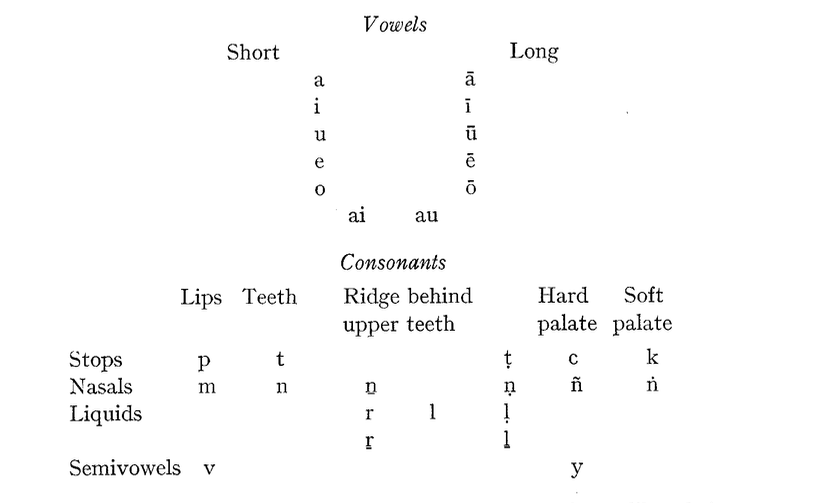
The Tamil long vowels are simply long vowels, unlike their English diphthongized counterparts. Final -ai is pronounced approximately like -ey.
Tamil has two series of consonants unfamiliar to English speakers: the dentals t, n and the retroflexes ṭ, ṇ, ḷ, ḻ. The dentals are pronounced with the tongue at the teeth, the retroflexes are produced by curling the tongue back towards the roof of the mouth (cf. American pronunciation of girl, sir).
In the middle of Tamil words, long consonants occur. In transliteration, they are indicated by double letters (cf. Nakkīrar, pāṭṭu). English has long consonants between words, cf. Mac Kinley, four roads, hot tea.
The Tamil r is flapped or trilled as in some European languages like Spanish, Italian or Czech. The ḻ is somewhat like the American variety of r; r and ṟ are not distinguished by most modern Tamil speakers, but long ṟṟ is pronounced like tr in English trap or tt in hot tea; nr is pronounced ndr as in laundry.
p, t, ṭ, c, k are pronounced differently according to their positions: initially, p, t, and k are pronounced as voiceless stops, ṭ does not occur, and c is initially pronounced as s or sh. Between vowels, p, t, ṭ are voiced into b, d, and ḍ and pronounced as lax voiced stops; k and c are pronounced as gh or h and s or sh. After nasals, all stops are voiced into b, d, ḍ, j, g.
Instances: akam is pronounced usually aham, caṅkam is pronounced sangam, kapilar is pronounced kabilar, kuṟuntokai as kurundohey, naṟṟiṇai as natriney or nattiney, tolkāppiyam as tolhaapiyam.
Linguistic Map of India